







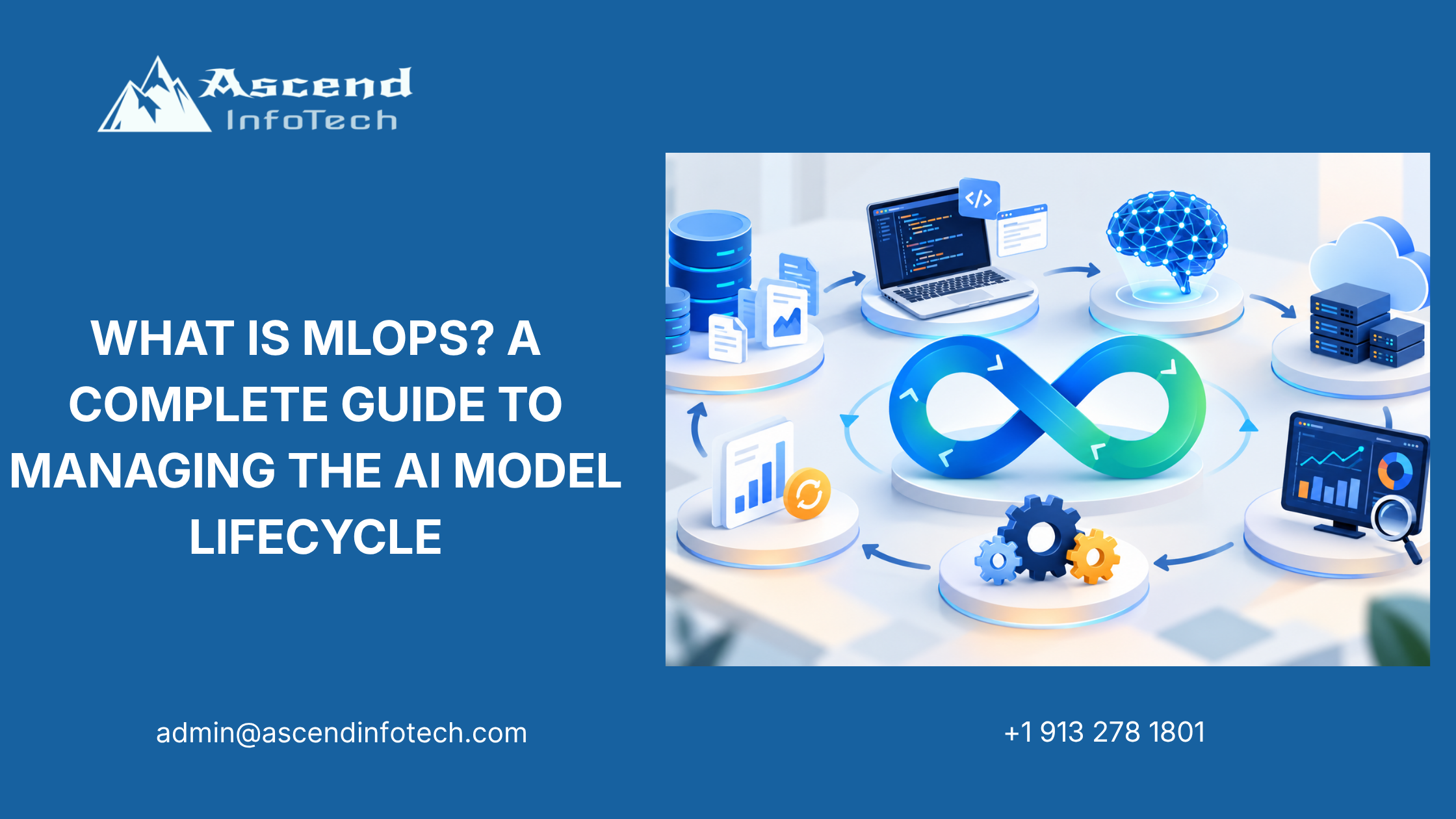
What Is MLOps? A Complete Guide to Managing the AI Model Lifecycle
A machine-learning model can perform well in testing and still lose accuracy after it reaches production. Customer behaviour changes, data sources evolve, business rules are updated and the relationship between inputs and outcomes can shift.
What is MLOps? MLOps, short for machine learning operations, is the set of practices, processes and tools used to develop, deploy, monitor and maintain machine-learning models in production. It brings data science, software engineering and operations together around a repeatable model lifecycle.
The aim is not simply to release a model. It is to keep that model reliable, traceable and useful as the surrounding business environment changes.
What Is MLOps?
A working definition
MLOps applies DevOps principles to machine-learning systems, while accounting for the additional complexity of data, experimentation, model quality and retraining. Google Cloud describes it as a process that manages the ML lifecycle from development through deployment and monitoring.
A typical MLOps practice covers:
- Data extraction and preparation.
- Feature engineering.
- Experiment tracking.
- Model training and evaluation.
- Model validation.
- Deployment and serving.
- Production monitoring.
- Governance and version control.
- Retraining and redeployment.cloud.
A traditional software release usually changes code. An ML release can change code, training data, features, model parameters, dependencies and infrastructure at the same time. MLOps gives teams a way to manage those changes together.
Why MLOps matters
Without MLOps, teams often rely on notebooks, manual handoffs and undocumented scripts. That creates several problems:
- Nobody knows which data produced a deployed model.
- Reproducing an experiment becomes difficult.
- Model versions cannot be compared easily.
- Production issues are discovered late.
- Retraining depends on one or two people.
- Governance evidence is incomplete.
- A successful pilot becomes difficult to operate at scale.
Google Cloud identifies automation and monitoring across integration, testing, release, deployment and infrastructure management as central MLOps practices.
The MLOps Lifecycle
1. Define the business use case
The lifecycle begins before a data scientist trains a model. The team first defines:
- Which business problem the model will address.
- Who will use the prediction?
- What action the prediction will support.
- Which metric represents success?
- What level of error is acceptable.
- What constraints apply to privacy, fairness or regulation.
A model can have excellent technical metrics and still fail commercially if it does not improve a decision or workflow.
For example, a customer-churn model should not be judged only on AUC. The team may also need to measure retention cost, campaign conversion and the percentage of customers who receive an appropriate intervention.
2. Collect and prepare data
The team identifies relevant sources, extracts data and prepares it for training. This may involve:
- Removing duplicates.
- Handling missing values.
- Correcting inconsistent formats.
- Joining data from multiple systems.
- Creating labels.
- Splitting data into training, validation and test sets.
- Documenting data lineage.
Data preparation and feature engineering are important because the model learns from the signals made available to it. Google Cloud includes data extraction, analysis, preparation and feature engineering as core steps before training.cloud.
3. Experiment and train models
Data scientists test algorithms, features and parameters to identify a suitable candidate. MLOps encourages experiment tracking so the team records:
- Dataset version.
- Feature definitions.
- Algorithm and model version.
- Hyperparameters.
- Evaluation metrics.
- Code commit.
- Training environment.
- Generated model artifact.
This record helps the team reproduce a result and understand why one model performed better than another.
4. Validate the candidate model
Validation checks whether the model is suitable for production, not merely whether it performs well on a test dataset.
Review:
- Accuracy or error metrics.
- Performance against a baseline.
- Results across important user or customer segments.
- Bias and fairness indicators.
- Robustness to missing or unusual inputs.
- Latency and resource requirements.
- Security and privacy requirements.
- Compatibility with the serving environment.
A candidate should not be promoted simply because it has the highest average score. A small improvement in overall accuracy may hide worse performance for an important segment.
5. Deploy and serve predictions
Once approved, the model is moved into a production environment. It may serve predictions through:
- A REST API.
- A batch-scoring pipeline.
- An embedded application.
- An edge or mobile device.
- A data warehouse or analytics platform.
Model deployment is not the same as copying a model file to a server. The team must also deploy the supporting data pipeline, feature logic, dependencies, configuration, access controls and monitoring. Google Cloud notes that a production ML system often includes a complete training and serving pipeline rather than only the prediction artifact.
6. Monitor production behaviour
Production monitoring checks whether the model remains reliable after release. Important monitoring areas include:
| Monitoring area | What it reveals |
| Model quality | Whether predictions still match known outcomes |
| Input drift | Whether production features differ from the training baseline |
| Concept drift | Whether the relationship between inputs and outcomes has changed |
| Data quality | Whether features are missing, stale or outside expected ranges |
| Operational health | Whether latency, errors and availability remain acceptable |
| Fairness | Whether performance differs across important groups |
| Cost | Whether inference remains economically viable |
Snowflake describes model monitoring as comparing production behaviour with expected ranges across inputs, predictions, outcomes and runtime conditions.
7. Retrain or roll back
Monitoring should lead to a defined response. The team may:
- Investigate an upstream data problem.
- Repair a feature pipeline.
- Retrain using recent labelled data.
- Replace a feature.
- Adjust a decision threshold.
- Roll back to a previous model.
- Pause automated decisions.
- Escalate to a model owner.
Retraining should not happen automatically after every alert. A drift signal may indicate a source-system error rather than a genuine change in customer behaviour.
Why Models Degrade Over Time
Data drift
Data drift occurs when the distribution of model inputs changes from the training or reference distribution. A fraud model may start seeing different transaction values, locations or payment methods than it saw during training.
The model still accepts the inputs, but the inputs no longer resemble the conditions from which it learned. This can reduce prediction quality.
Concept drift
Concept drift occurs when the relationship between an input and the target outcome changes. For example, a churn signal that worked before a pricing change may become less useful after the pricing model changes.
Concept drift is difficult to detect because it requires actual outcome labels. Those labels may arrive days or months after the prediction. Teams often use input drift, prediction patterns and business indicators as early signals while waiting for ground truth.
Data-quality degradation
A model can also lose reliability because the data pipeline changes. Common examples include:
- A required field becomes mostly null.
- A source changes date format.
- A new category appears.
- A feature arrives later than expected.
- A transformation calculation changes.
- A join begins producing duplicate rows.
These are data problems, but they appear as model problems if nobody monitors the input layer.
Business and behaviour changes
Models operate inside changing organisations. New products, marketing campaigns, regulations, economic conditions and customer habits can make old patterns less useful.
Snowflake reports that model degradation was observed in 91% of model-data pairs across a study of 32 datasets and four model types. The exact rate will vary by use case, but the operational lesson is clear: strong test performance does not guarantee stable production performance.
What MLOps Monitoring Should Track
Model performance metrics
Select metrics based on the business decision and the cost of errors.
For classification:
- Accuracy.
- Precision.
- Recall.
- F1 score.
- AUC.
- Calibration.
For regression:
- Mean absolute error.
- Root means squared error.
- Mean absolute percentage error.
- R2R^2R2.
A fraud team may prioritise recall because missed fraud is expensive. A marketing team may prioritise precision because unnecessary outreach wastes budget.
Drift metrics
Teams can compare production data against a reference distribution using measures such as:
- Population Stability Index.
- Kolmogorov–Smirnov statistic.
- Wasserstein distance.
- Kullback–Leibler divergence.
Drift metrics should not be read in isolation. A small shift in a highly influential feature may matter more than a large shift in a feature with little impact on predictions.
Data-quality metrics
Track:
- Null rates.
- Schema changes.
- Invalid values.
- Freshness.
- Range violations.
- Category changes.
- Duplicate records.
- Training-serving skew.
The data-quality layer often provides the earliest warning that a model may become unreliable.
Operational metrics
A model can be accurate and still fail its application if it is too slow or unavailable. Monitor:
- Response latency.
- Throughput.
- Error rate.
- Availability.
- Resource use.
- Inference cost.
- Queue depth.
For generative AI systems, teams may also monitor token use, retrieval latency, response quality and tool-call failures.
MLOps Levels of Maturity
Manual process
At this level, data scientists run notebooks and scripts manually. A model is handed to engineering for deployment, and retraining may happen only when someone notices a problem.
Characteristics include:
- Manual data preparation.
- Limited experiment tracking.
- Infrequent releases.
- No automated validation.
- Little or no production monitoring.
- Heavy dependence on individual expertise.
This may work for an early experiment, but it becomes risky when several models support business decisions.
1: Automated training pipeline
The team automates parts of the ML pipeline and introduces continuous training. Data validation, model validation and pipeline triggers are added before a new model can be promoted.
Triggers may include:
- A schedule.
- New labelled data.
- Performance degradation.
- Significant data-distribution change.
- A manual approval.
The team gains repeatability but may still deploy pipeline changes manually.
2: CI/CD and continuous training
At this level, source control, testing and deployment are connected to the ML pipeline. A code change can trigger:
- Build and unit tests.
- Data and schema validation.
- Model training.
- Model evaluation.
- Model registration.
- Deployment to a test environment.
- Approval or automated promotion.
- Production monitoring.
Google Cloud describes this level as combining CI/CD automation for pipeline components with continuous delivery of model-serving systems.
MLOps Tools
Experiment tracking and model registry
Tools such as MLflow help teams track experiments, store model artifacts and manage model versions. A registry should show:
- Model name and version.
- Training dataset.
- Evaluation metrics.
- Approval status.
- Deployment environment.
- Owner.
- Release date.
- Rollback option.
Pipeline orchestration
Orchestration tools manage the sequence from data preparation through training, validation and deployment. Options may include managed cloud pipelines, Kubeflow, Airflow or platform-specific services.
The tool matters less than the repeatability of the process. A pipeline should be versioned, testable and able to stop safely when data validation fails.
Monitoring and observability
Monitoring platforms track data quality, drift, model performance and infrastructure health. A useful dashboard shows both technical and business metrics.
For example:
| Technical signal | Business signal |
| Input drift | Change in approval or conversion rate |
| Latency | Customer response time |
| Null-rate spike | Increase in manual review |
| Model recall decline | Missed fraud or service cases |
| Inference cost | Cost per completed decision |
Connecting these two sides helps teams distinguish a technical alert from a business-impacting incident.
Governance and Risk Controls
MLOps supports responsible operation by keeping a record of how a model was built and released. Governance practices may include:
- Model inventory.
- Data lineage.
- Version control.
- Approval workflows.
- Access management.
- Bias and fairness testing.
- Security reviews.
- Incident response.
- Documentation of intended use.
- Retirement procedures.
A model should have a named owner after deployment. That owner is accountable for performance, risk reviews, monitoring and retirement decisions.
How MLOps Protects AI ROI
AI ROI can disappear when a model silently degrades, requires constant manual intervention or produces decisions nobody trusts. MLOps protects the investment by:
- Reducing deployment errors.
- Making experiments reproducible.
- Shortening release cycles.
- Detecting data and model drift.
- Triggering appropriate retraining.
- Providing rollback options.
- Making model costs visible.
- Connecting model metrics to business outcomes.
The value comes from operating the model reliably over time, not from the initial demonstration.
Conclusion:
MLOps is the operating discipline that keeps an ML model useful after launch. It connects data preparation, training, validation, deployment, monitoring and retraining into a managed lifecycle. For CAIOs and CTOs, the goal is not to add tools for their own sake. It is to make model performance visible, releases repeatable and AI investments dependable in production.
Frequently Asked Questions
What is MLOps?
What is MLOps? MLOps is the set of practices and tools used to manage the machine-learning lifecycle from data preparation and model training to deployment, monitoring, retraining and governance.cloud.
What is the difference between MLOps and DevOps?
DevOps manages the software development and operations lifecycle. MLOps applies similar practices to ML systems but also manages training data, features, model validation, experiment tracking, drift and retraining.cloud.
Why do ML models degrade after deployment?
Models degrade when production data, customer behaviour, business rules or the relationship between inputs and outcomes changes from the conditions present during training. Data-quality failures and pipeline changes can also reduce performance.
What is model drift?
Model drift is a change in production conditions that makes a model’s original assumptions less reliable. Data drift affects input distributions, while concept drift changes the relationship between inputs and target outcomes.
Does MLOps automatically retrain models?
It can support automated retraining, but retraining should follow defined triggers and validation gates. A drift alert may indicate a data-pipeline problem rather than a need for a new model.docs.cloud.
Which tools are used in MLOps?
Common categories include experiment tracking, model registries, pipeline orchestration, feature stores, CI/CD platforms, data-quality tools and monitoring systems. MLflow is one widely used option for experiment and model management.
Is MLOps needed for every ML project?
A small experiment may not need a full MLOps platform. Once a model influences production decisions, customer experiences or regulated processes, teams need repeatable deployment, monitoring, governance and rollback practices.