







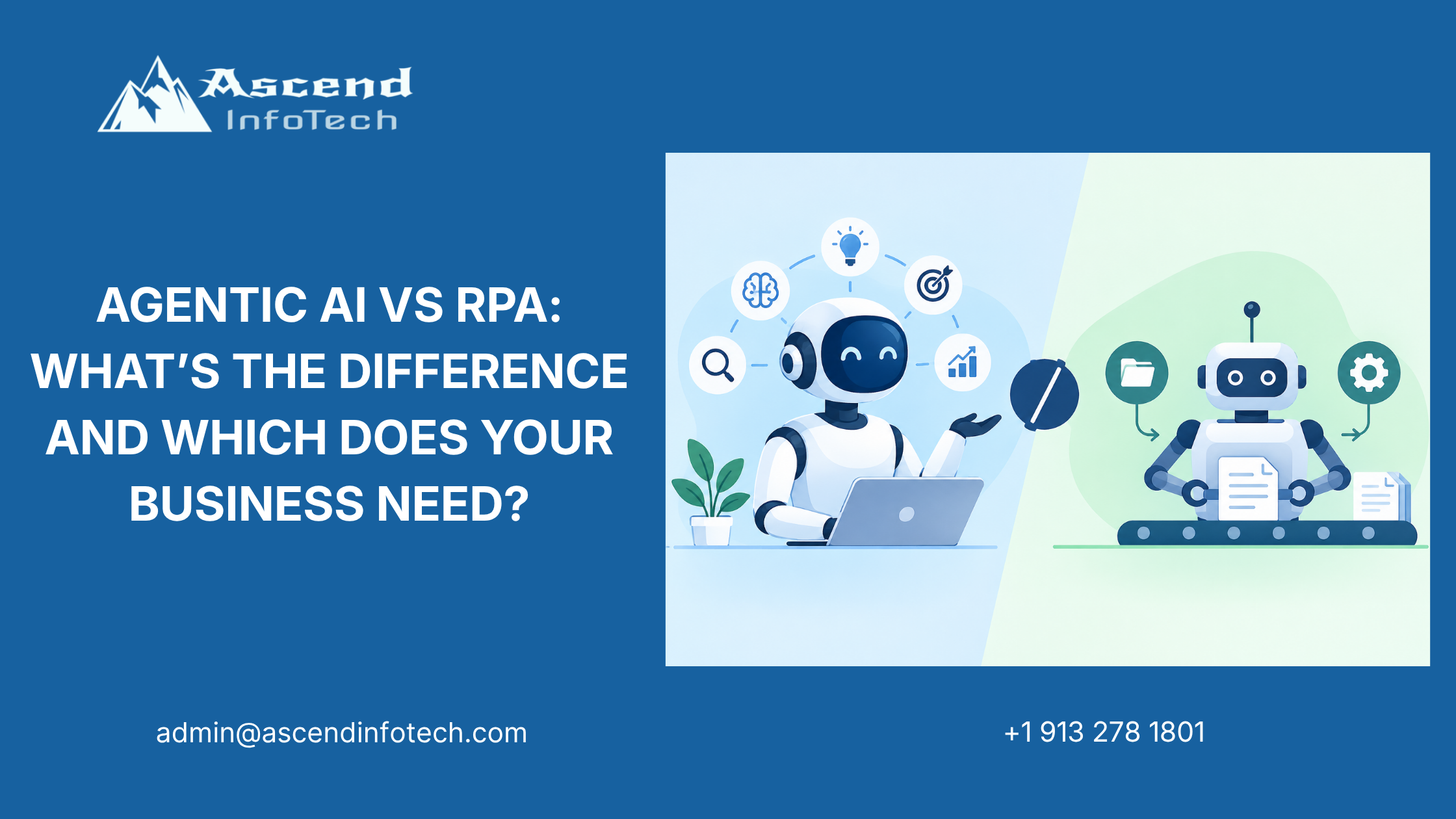
Agentic AI vs RPA: What’s the Difference and Which Does Your Business Need?
RPA bots are excellent at repeating a fixed process. Agentic AI is designed to interpret changing inputs, make context-based decisions and coordinate several steps toward a goal. Choosing between them is not about selecting the newer technology. It is about matching the automation method to the work.
The practical question in agentic AI vs RPA is simple: does the process depend on fixed structure or on meaning and judgement? If the data is predictable and the rules rarely change, RPA may be the right fit. If the process involves documents, language, exceptions or changing conditions, an AI agent may be more suitable.
Many enterprise workflows need both. RPA can handle stable execution while an AI agent interprets unstructured information and routes exceptions.
What Is RPA?
Rule-based automation
Robotic process automation uses software bots to follow predefined instructions. The bot may click through a user interface, copy values between systems, call an API or update a database.
RPA works well when:
- Inputs are structured.
- Rules are clear.
- The process is repetitive.
- The application interface is stable.
- The expected output is deterministic.
- Auditability matters.
Common examples include:
- Moving data from email attachments into an ERP system.
- Updating customer records across applications.
- Processing standard invoice templates.
- Generating scheduled reports.
- Checking fixed fields in forms.
- Updating legacy systems that lack modern APIs.
RPA does not make a judgement about what information means. It follows the process designed by the automation team.
RPA’s main limitation
RPA is sensitive to changes outside its predefined path. A renamed button, revised screen layout, missing field or new document format can cause the bot to stop.
This is not necessarily a weakness. Predictability is the reason businesses use RPA for high-volume, stable processes. The limitation appears when teams try to apply the same method to work that contains frequent exceptions.
What Is Agentic AI?
Goal-based automation
Agentic AI uses AI models, tools and orchestration logic to pursue a defined goal. It can interpret content, plan a sequence, call systems, review outputs and decide whether to continue or ask for human assistance.
An agentic workflow may:
- Receive a business objective.
- Break the objective into tasks.
- Retrieve relevant information.
- Choose an approved tool or system.
- Perform an action.
- Check the result.
- Route the case, retry or escalate.
The system is not fully unrestricted. Enterprise agents need defined permissions, approved tools, monitoring and clear escalation rules.
Agentic AI’s main limitation
AI agents can handle variability, but they introduce a different category of risk. An RPA bot usually fails visibly when a selector changes. An AI agent may produce a plausible but incorrect interpretation.
That means agentic workflows need:
- Output validation.
- Confidence thresholds.
- Human review for sensitive decisions.
- Detailed action logs.
- Fallback paths.
- Permission controls.
- Ongoing testing.
TechTarget describes AI agents as more flexible than RPA, but also more experimental and prone to error.
Agentic AI vs RPA: Core Differences
| Dimension | RPA | Agentic AI |
| Operating model | Follows predefined instructions | Pursues a goal through planning and tool use |
| Data type | Structured forms, tables and fixed templates | Unstructured and semi-structured text, documents and messages |
| Decision-making | If/then rules | Context-based interpretation and routing |
| Flexibility | Low to moderate | Moderate to high |
| Output | Predictable and repeatable | Probabilistic and variable |
| Setup | Process mapping, bot design and system access | Model, tools, instructions, validation and orchestration |
| Maintenance | UI, API and rule changes | Model behaviour, prompts, schemas and safeguards |
| Auditability | Usually straightforward | Requires deliberate logging and explanation |
| Latency and cost | Often low and predictable | May be higher because of model calls |
| Ideal role | Execution of stable tasks | Interpretation, decisions and exception handling |
The choice should be made at the workflow-step level, not only at the process level. A single business process may contain both fixed and variable work.
When to Choose RPA
Stable, repetitive processes
Choose RPA when the workflow has a clear sequence and little variation.
Examples:
- Copying structured customer fields between systems.
- Updating a legacy application.
- Downloading daily reports.
- Validating a fixed set of fields.
- Sending a standard notice after a known event.
- Reconciling records using exact matching rules.
A simple rule applies: when inputs are consistent and the logic does not change, RPA is usually a strong option.
RPA strengths
The RPA may be appropriate when you need:
- Fast deployment for a narrow process.
- Deterministic results.
- High transaction volume.
- Clear audit trails.
- Low per-task processing cost.
- Compatibility with older applications.
- Minimal judgement in the workflow.
The RPA also remains useful where an API is unavailable but employees can complete the task through a stable user interface.
RPA warning signs
RPA may struggle when:
- Document formats change frequently.
- Email requests use natural language.
- Exceptions represent a large share of cases.
- Business rules require interpretation.
- Teams constantly patch the bot.
- A person must review context before deciding the next step.
When these conditions appear, consider adding an AI agent to the specific step that requires interpretation rather than replacing the entire automation.
When to Choose Agentic AI
Variable inputs and judgement
Choose agentic AI when the work depends on meaning, context or changing conditions.
Suitable examples include:
- Reading non-standard invoices.
- Classifying customer emails.
- Reviewing contract clauses.
- Summarising case history.
- Investigating support-ticket context.
- Comparing documents against business requirements.
- Routing claims based on several signals.
- Preparing a recommendation for human approval.
Agentic AI is especially useful when writing every possible rule would create a large and difficult-to-maintain decision tree.
Agentic AI strengths
An AI agent may be a good fit when you need:
- Natural-language understanding.
- Document interpretation.
- Context-based classification.
- Multi-step planning.
- Adaptation to changing inputs.
- Exception routing.
- Recommendations based on several sources.
- Actions across connected enterprise systems.
The agent still needs structure around it. A model should not be allowed to make unrestricted changes to a financial, customer or operational system.
Agentic AI warning signs
Do not begin with agentic AI when:
- The process is already simple and deterministic.
- A fixed rule can solve the problem reliably.
- The cost of a wrong decision is high and no human review is available.
- Source data is unreliable or inaccessible.
- Success cannot be measured.
- No one owns the workflow after deployment.
- The team cannot monitor model behaviour.
An AI agent adds complexity. Use it where that complexity solves a real business problem.
Setup Cost and Operating Cost
RPA cost profile
RPA often has a clearer cost profile because the work is based on defined rules. Costs may include:
- Process discovery.
- Bot development.
- Platform licences.
- System access.
- Testing.
- Ongoing maintenance after application changes.
The main operational burden is maintaining the bot when screens, fields, APIs or rules change.
Agentic AI cost profile
Agentic AI costs include:
- Model usage.
- Data preparation.
- Workflow orchestration.
- API and system integration.
- Prompt or instruction design.
- Evaluation and testing.
- Monitoring.
- Human review.
- Security and governance.
AI agents can also introduce inference latency and usage-based costs. Sending every low-value transaction through a large reasoning model may be unnecessary.
A sensible design uses smaller or deterministic methods for simple work and reserves advanced reasoning for tasks that actually require it.
Cost comparison
| Cost factor | RPA | Agentic AI |
| Initial design | Process mapping and bot development | Workflow design, model selection and tool setup |
| Data preparation | Usually structured input mapping | Often requires document, text or knowledge preparation |
| Testing | Rule and path testing | Scenario, quality, safety and edge-case testing |
| Runtime cost | Often stable and predictable | Varies by model, token use and workflow length |
| Maintenance | Fix broken selectors, fields and rules | Refine instructions, schemas, safeguards and model behaviour |
| Human oversight | Often limited to exceptions | Usually needed for low-confidence or high-risk cases |
The cheapest option is not always the lowest-cost option. A low-cost RPA bot that fails on 30% of transactions may create more manual work than a hybrid design.
Real-World Use Cases
Invoice processing
Invoice processing often contains both structured and unstructured work.
RPA can:
- Open a standard invoice file.
- Extract fixed fields.
- Enter values into an ERP system.
- Match exact invoice and purchase-order numbers.
Agentic AI can:
- Read invoices in different layouts.
- Interpret line-item descriptions.
- Identify a mismatch between an invoice and purchase order.
- Draft a supplier query.
- Decide whether the case needs review.
A hybrid flow may look like this:
- RPA receives the invoice.
- AI reads and classifies its contents.
- A validation layer checks required fields.
- RPA writes approved values to the finance system.
- Exceptions go to an accounts-payable reviewer.
Customer support
A standard cancellation request with a valid order number may be handled through rules or API logic. A message such as “The invoice looks wrong and the service failed again last Thursday” requires interpretation.
An AI agent can identify whether the message relates to billing, service disruption or escalation. RPA can then update the correct system after the classification has been validated.
Customer onboarding
RPA can:
- Enter structured application fields.
- Copy verified information into an account system.
- Send standard notifications.
Agentic AI can:
- Read varied identity documents.
- Identify missing information.
- Compare customer explanations with submitted evidence.
- Route unusual cases for review.
TechTarget lists customer onboarding as a strong hybrid use case, with RPA handling data entry and AI agents making decisions based on customer information.
Insurance claims
RPA handles predictable claims steps such as moving structured policy information and opening a case. An AI agent can interpret complex documents, summarise the incident and identify cases that need specialist attention. High-risk claims should retain human approval regardless of which automation method is used.
When to Combine Both
A hybrid workflow pattern
Many businesses should not choose between RPA and agentic AI. They should divide the workflow into tasks and assign the right tool to each one.
A common architecture looks like this:
- Capture: RPA or an API receives the input.
- Interpret: Agentic AI reads unstructured content.
- Validate: Rules check required fields and permitted values.
- Decide: The system routes the case based on defined thresholds.
- Execute: RPA or an API updates the system of record.
- Escalate: A human reviews uncertain or sensitive cases.
- Monitor: Logs record inputs, actions, results and exceptions.
RPA can execute reliably while AI handles analysis. This combination is recommended when a process includes structured and unstructured elements.
The handoff is the critical design point
The AI-to-RPA handoff needs a strict schema. Do not send free-form model text directly into a financial or customer record.
Define:
- Required output fields.
- Permitted values.
- Confidence threshold.
- Missing-field behaviour.
- Human-review condition.
- Error and retry path.
For example, an invoice-classification agent might return:
json
{
“invoice_status”: “match”,
“purchase_order_id”: “PO-10428”,
“confidence”: 0.94,
“exception_reason”: null,
“human_review_required”: false
}
A validation step should reject malformed or incomplete output before RPA writes anything to the ERP system.
Decision Framework
Use this six-question test
Ask these questions for each step in the workflow:
- Is the input structured and predictable?
- Are the rules stable and easy to describe?
- Does the task require judgement or interpretation?
- How expensive is an incorrect action?
- Is a reliable API available?
- Can a human review uncertain cases?
Use the following guide:
| Answer pattern | Recommended approach |
| Structured input, fixed rules, low variation | RPA or direct API integration |
| Unstructured input, interpretation required | Agentic AI with validation |
| Structured and unstructured stages | Hybrid RPA and agentic AI |
| High-risk decision with no reviewer | Keep a human-led process |
| Stable legacy interface with no API | RPA may be appropriate |
| Frequent exceptions and changing context | Agentic AI may help |
| Simple process with low volume | Manual work or light automation may be cheaper |
If an API is available, a direct integration may be more reliable than RPA. RPA is most useful when the system cannot be connected through a suitable interface.
A practical scoring matrix
Score each factor from 1 to 5:
| Factor | Score 1 | Score 5 |
| Input variation | Fixed | Highly variable |
| Need for judgement | None | Significant |
| Rule-change frequency | Rare | Frequent |
| Exception volume | Very low | Very high |
| Data structure | Fully structured | Mostly unstructured |
| Risk of wrong action | Low | High |
A high score for variation, judgement and exception volume points toward agentic AI. A low score across these areas points toward RPA. A high-risk workflow should add human approval even when an agent is used.
Governance and Security
Controls for RPA
RPA governance should cover:
- Bot identity and credentials.
- System access.
- Change management.
- Logs and transaction history.
- Failure alerts.
- Segregation of duties.
- Business-owner approval.
RPA is deterministic, but an incorrectly configured bot can still make thousands of wrong updates quickly.
Controls for agentic AI
Agentic AI requires additional controls:
- Permissioned tool access.
- Prompt and instruction management.
- Data-loss prevention.
- Model and output monitoring.
- Action logging.
- Human approval for sensitive actions.
- Confidence and uncertainty handling.
- Testing against prompt injection and malicious documents.
AI agents are more flexible but less predictable than RPA, so they need stronger guardrails and oversight.
Measure business results
Track the outcome of the automation, not only the number of automated tasks:
- Cycle time.
- Exception rate.
- Error rate.
- Manual hours saved.
- Cost per transaction.
- Customer satisfaction.
- Rework.
- Approval time.
- Number of actions reversed.
An AI agent that completes more tasks but creates expensive rework is not delivering value.
Conclusion:
The right choice in agentic AI vs RPA depends on the nature of the work. Use RPA for predictable, rule-based execution. Use agentic AI for variable inputs, interpretation and exception handling. When a process contains both, a hybrid model can deliver reliable system execution while adding AI where human judgement is currently slowing the workflow.
Frequently Asked Questions
- What is the main difference in agentic AI vs RPA?
RPA follows predefined rules for structured and predictable tasks. Agentic AI interprets context, plans actions and adapts when inputs or conditions change.
- Is agentic AI replacing RPA?
No. RPA remains useful for stable, high-volume processes with deterministic outputs. Agentic AI adds value where the workflow involves unstructured data, judgement or frequent exceptions. The two can work together.
- Is RPA cheaper than agentic AI?
RPA often has a more predictable runtime cost, while agentic AI can add model, integration, monitoring and review costs. The right comparison should include maintenance, exception handling and the cost of incorrect decisions.
- Which is more accurate: RPA or agentic AI?
RPA is more predictable when the process and inputs match its predefined rules. Agentic AI is more capable with variable content but can produce incorrect interpretations. Use validation and human review for important actions.
- Can RPA and agentic AI work together?
Yes. RPA can collect data and update systems, while an AI agent interprets documents, classifies exceptions or prepares a recommendation. This hybrid model is useful for invoice processing, onboarding, claims and support workflows.
- When should a business avoid agentic AI?
Avoid it when a simple rule or direct API can solve the problem, the source data is unreliable, no one can monitor the workflow or a wrong action would be unacceptable without human review.
- What is the first step when choosing between them?
Map the workflow step by step and identify where the current process fails. Use RPA for stable execution, agentic AI for interpretation and a hybrid design when both types of work appear in the same process.