







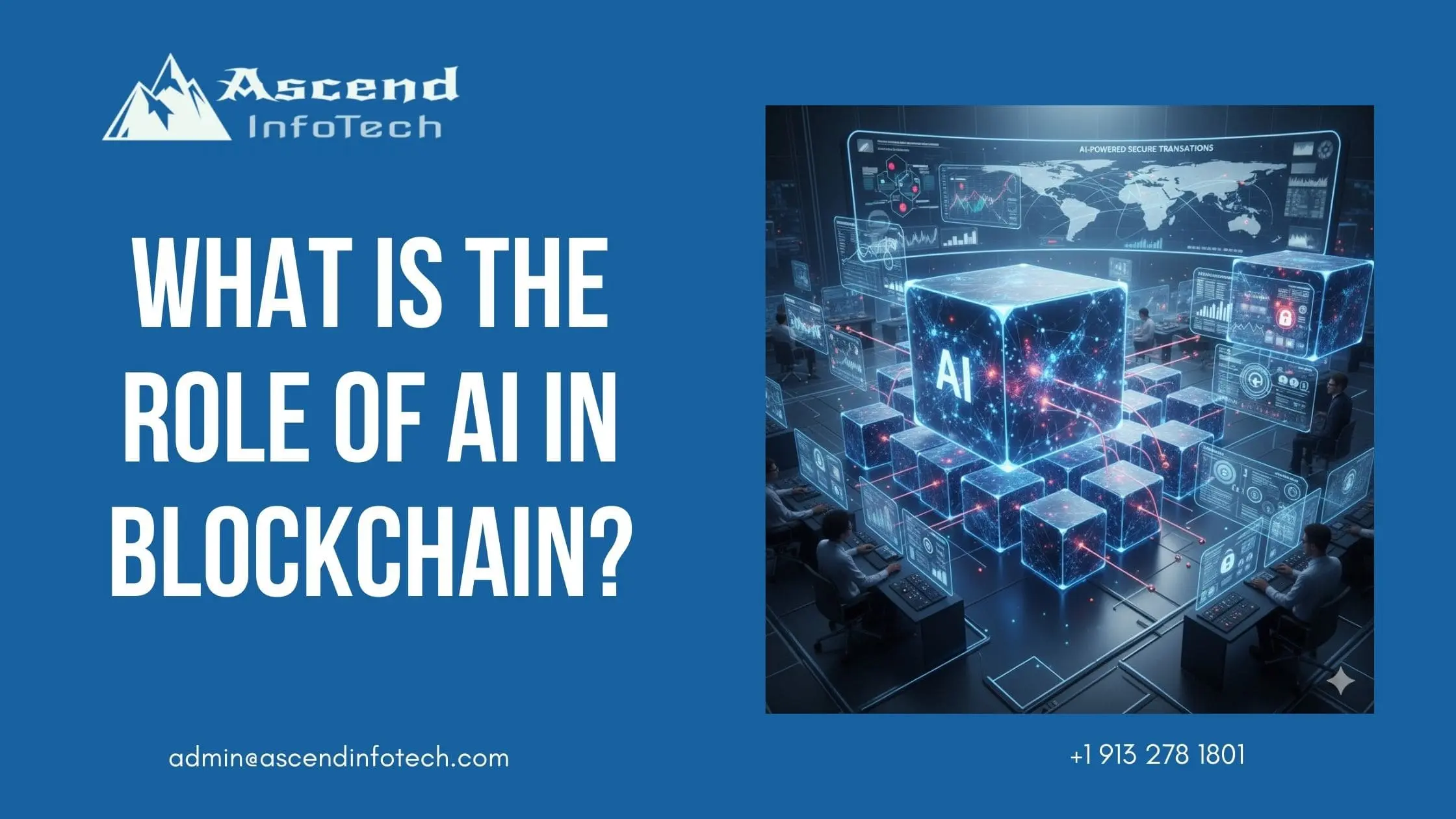
What is the Role of AI in Blockchain?
Blockchain and artificial intelligence are two of the most revolutionary technologies influencing the modern digital world. While AI focuses on intelligent decision-making and automation, blockchain ensures transparency, decentralization, and security.
The convergence of these two fields has opened up new possibilities, and in 2025 the discussion around AI in blockchain is gaining significant momentum.
Businesses and industries are exploring how artificial intelligence can enhance blockchain systems by improving security, scalability, and decision-making. This integration is not just a technological trend but a step toward building smarter, more efficient, and trustworthy digital ecosystems.
The purpose of this article is to explore the role of AI in enhancing blockchain applications, uncovering its real-world uses, benefits, and potential for the future.
The Intersection of AI and Blockchain
The intersection of AI and blockchain is reshaping how businesses manage data, security, and decision-making. Artificial intelligence enhances blockchain systems by analyzing large volumes of transaction data, detecting anomalies, and improving scalability.
It brings intelligence to automated processes, such as refining smart contracts and optimizing network performance. On the other hand, blockchain supports artificial intelligence by ensuring data integrity, transparency, and security, which are critical for training reliable models.
Together, they create a powerful synergy where decentralized trust meets intelligent decision-making, paving the way for secure, transparent, and highly efficient digital ecosystems across finance, healthcare, and supply chains.
Key Roles of AI in Blockchain
The integration of AI in blockchain is reshaping how businesses and industries operate by making decentralized systems more intelligent, secure, and efficient.
While blockchain ensures transparency and trust, artificial intelligence adds predictive insights and automation to unlock new possibilities. Here are five key roles AI plays in blockchain:
1. Fraud Detection and Security
AI algorithms play a vital role in detecting anomalies within blockchain transactions by analyzing large volumes of data in real time. This proactive monitoring helps prevent fraud, identify suspicious activities, and protect users from cyberattacks, ultimately making blockchain networks more resilient and trustworthy for businesses and individuals.
2. Smarter Smart Contracts
Blockchain smart contracts can be made more dynamic and context-aware by incorporating artificial intelligence. Instead of remaining static, these contracts can analyze real-world data, learn from past outcomes, and adjust automatically to new conditions, ensuring fair, efficient, and autonomous execution without the need for constant human oversight.
3. Scalability and Performance Optimization
Scalability is one of the key problems of blockchain, as excessive transaction loads cause performance to lag. AI helps overcome this by predicting network congestion, optimizing consensus algorithms, and reducing unnecessary energy use in mining or validation. This leads to faster, more efficient transactions and sustainable blockchain operations across industries.
4. Data Analytics and Insights
Blockchain data is vast but often unstructured. AI transforms this raw information into meaningful insights by identifying trends, patterns, and correlations. Businesses can leverage these insights for smarter decision-making, developing better decentralized applications (dApps), and gaining a competitive advantage, all while maintaining blockchain’s transparency and integrity of information.
5. Identity Verification and KYC
AI enhances blockchain-based identity systems through biometric authentication, facial recognition, and automated KYC checks. This reduces fraud, speeds up onboarding processes, and ensures data security. When combined with blockchain’s immutable records, users gain a reliable and tamper-proof digital identity system that improves trust across financial services and online platforms.
Real-World Use Cases of Artificial intelligence in Blockchain
The integration of AI in blockchain is not just a theoretical concept but a reality shaping industries worldwide. By combining artificial intelligence with the trust and transparency of blockchain, businesses are building smarter, more secure, and efficient systems. Here are some of the most used applications:
1. AI in Crypto Trading Bots
Crypto markets move at lightning speed, making it impossible for humans to analyze data and react instantly. AI-driven trading bots, when integrated with blockchain platforms, can scan market patterns, predict price movements, and execute trades with higher accuracy. This reduces risks and provides investors with automated strategies that adapt to real-time data.

2. AI for Blockchain-Based Healthcare Data Sharing
Healthcare generates massive amounts of sensitive patient data that must remain secure yet accessible. By using blockchain for secure storage and artificial intelligence for data analysis, medical providers can share information seamlessly while protecting patient privacy. AI can help detect health trends or predict outbreaks, while blockchain ensures the authenticity and integrity of records.
3. AI + Blockchain in Supply Chain Transparency
Supply chains often face issues of fraud, inefficiency, and lack of visibility. Blockchain creates a tamper-proof record of transactions, and artificial intelligence can analyze this data to identify inefficiencies, predict demand, or optimize logistics. This powerful combination improves transparency, reduces costs, and builds trust between suppliers, manufacturers, and consumers.
4. AI-Powered Fraud Detection in Financial Systems
Financial fraud is a growing global issue. Blockchain provides a secure and transparent record of transactions, while AI algorithms can detect unusual behavior, flagging fraudulent activity in real time. Together, they create a stronger defense system for banks, payment providers, and crypto platforms, reducing risks and enhancing customer trust.

Will AI Take Over Blockchain?
No, AI will not replace or take over blockchain, because both technologies serve very different purposes. Instead, Artificial intelligence and Blockchain complement each other.
- Blockchain is designed for decentralization, transparency, and security of data. Without depending on a centralized authority, it ensures trust.
- AI focuses on intelligence, automation, and making sense of large amounts of data. It can analyze patterns, predict outcomes, and optimize processes.

When combined, Artificial intelligence can make blockchain smarter, while blockchain can make artificial intelligence more trustworthy and secure.
For example, AI can improve fraud detection in blockchain transactions, while blockchain can ensure that artificial intelligence models use reliable, tamper-proof data.
In simple terms, AI is not here to take over blockchain. The real value lies in how both technologies work together to create new possibilities in finance, healthcare, cybersecurity, and beyond.
Conclusion
AI in Blockchain is no longer just a futuristic concept but a growing reality. From enhancing data security and fraud detection to powering smart contracts and optimizing decentralized finance, the integration of these two technologies is reshaping industries. The real potential lies not in AI or blockchain working alone but in their collaboration, where trust meets intelligence to drive innovation.
As this convergence accelerates, we can expect digital transformation to reach new levels of efficiency, transparency, and adaptability across finance, healthcare, logistics, and beyond. The journey of AI in Blockchain is just beginning, and its impact will continue to expand in the years ahead.
At Ascend InfoTech, we help businesses stay ahead by embracing cutting-edge technologies that shape the future. Ready to explore how AI in Blockchain can unlock growth for your business? Get in touch with us today and let’s build the future together.
