




Why AI Should Not Be Used in Schools for Effective Learning?
Technology is moving fast. Really fast. And somewhere in this race, artificial intelligence has found its way into our classrooms. Schools are adopting AI tools left and right, teachers are being encouraged to integrate them, and students are using them for everything from writing essays to solving math problems.
But here is the big question nobody seems to be asking loudly enough — should AI really be in schools at all?
Let’s talk about why AI should not be used in schools, at least not in the way it is being used right now. This is not about being anti-technology. This is about protecting the quality of education and the minds we are trying to shape.
The Real Purpose of Education Is Getting Lost
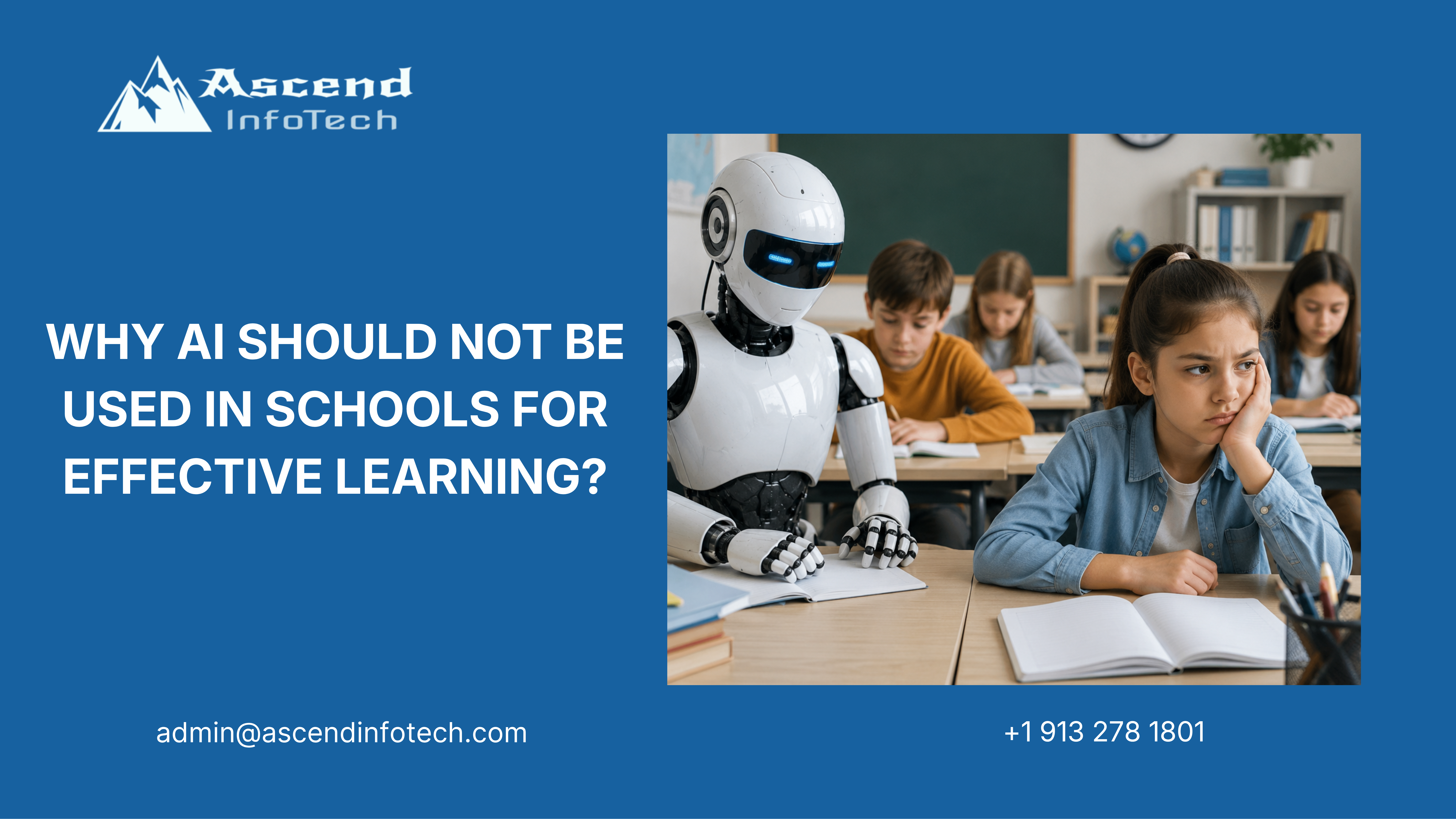
When a student sits down to write an essay, the goal is not just to produce a piece of writing. The goal is to think, struggle a little, form opinions, and learn how to express ideas clearly. That entire process builds critical thinking.
Now, when a student opens ChatGPT and asks it to write the essay for them, what exactly are they learning?
Nothing.
This is one of the strongest reasons why AI should not be used in schools. It shortcuts the very process that makes education valuable. The challenge is the lesson. When AI removes the challenge, it also removes the learning.
AI Dependency in Students Is a Growing Concern
Think about how we used to calculate. Mental math was a skill. Now, most people reach for a calculator for the simplest additions. AI is heading in the same direction, but on a much scarier scale.
AI dependency in students is already becoming visible. Students who regularly use AI tools for assignments struggle when those tools are not available. They feel lost without autocomplete suggestions. They cannot structure an argument without AI prompting them.
This over-reliance is dangerous. Education is supposed to prepare students for real life. And real life will not always have an AI tool open in a browser tab.
Disadvantages of AI in Education Go Deeper Than You Think

The disadvantages of AI in education are not just about cheating or laziness. They go much deeper.
- Reduced creativity: When students let AI generate ideas, their own creative thinking muscles stop getting used. Creativity needs practice. AI does that practice for them.
- Weaker memory retention: Studies have shown that when we struggle to recall something, the act of retrieval strengthens memory. AI gives answers instantly, completely bypassing this process.
- Poor writing skills: Grammar tools and AI writing assistants are making students worse writers, not better. They never learn to self-correct.
- Less emotional intelligence: Education is also about interactions, disagreements, and learning to communicate. AI cannot teach empathy or emotional nuance.
- Shallow understanding: A student who uses AI to summarize a chapter has processed it at the surface level. The deep understanding that comes from reading, re-reading, and discussing simply does not happen.
Must Read: The Role of AI in Student Performance Tracking
Risks of AI in School Environments
Beyond learning quality, there are very real risks of AI in school settings that parents and administrators need to take seriously.
- Privacy is a major concern
Many AI tools collect user data. When children use these platforms, their behavioral patterns, questions, and academic struggles are being stored by third-party companies. Parents rarely know this is happening.
- Misinformation is another risk
AI tools can be confidently wrong. They generate false information in a convincing tone, and students who do not have strong foundational knowledge cannot spot the errors. This is particularly dangerous in subjects like history, science, and current affairs.
- Unequal access creates a wider gap
Not all students have equal access to premium AI tools. This creates a situation where students from wealthier backgrounds can use more powerful AI, while others are left behind. AI is widening the gap it promised to close.
Can AI Replace Teachers? The Honest Answer

This is a question many educators quietly worry about. Can AI replace teachers?
The honest answer is no, but only if we choose to protect what teachers actually do.
A teacher does not just deliver information. A teacher reads a room. A teacher notices when a student is struggling emotionally, not just academically. A teacher builds relationships that motivate students to show up, try harder, and believe in themselves.
AI cannot replicate that human connection. It cannot notice that a quiet student in the back row has been looking sad for three days. It cannot pull a struggling student aside and say, “Hey, I believe in you.”
But here is the concern — if schools keep replacing teacher-led activities with AI-assisted ones, we will slowly erode the role of the teacher. And that would be one of the worst things we could do to education.
AI vs Traditional Education — What Actually Works?
When we look at AI vs traditional education, the data and common sense both point in the same direction. Traditional methods, when done well, build stronger foundations.
Reading physical books improves focus and comprehension. Writing by hand builds cognitive connections that typing simply does not. Group discussions teach communication and critical thinking. Project-based learning builds problem-solving skills through trial and error.
None of these benefits can be replicated by AI. In fact, AI often interrupts them.
There is also something to be said for the value of struggle in education. When students face a difficult problem and have to work through it, they build resilience. They learn that confusion is not failure — it is part of the process. AI removes that discomfort entirely, and in doing so, removes one of education’s most important lessons.
Why AI Is Bad for Students at a Developmental Stage?
The school years are not just about academics. They are about development — cognitive, social, emotional, and moral.
Why AI is bad for students becomes especially clear when you look at it through a developmental lens. Children and teenagers are at a stage where they are forming habits, building attention spans, and learning how to handle challenges. Introducing AI into this stage teaches them to outsource difficulty rather than face it.
There is also the attention span issue. AI tools are designed to give instant results. This trains students to expect instant results in everything. Deep focus, patience, and sustained effort — qualities that define successful people — are being quietly eroded.
This is why AI should not be used in schools without extremely careful limits and oversight. The risks to student development are real, measurable, and lasting.
What Schools Should Do Instead?
This is not about banning technology entirely. It is about being intentional.
- Teach students about AI critically, not just how to use it.
- Set clear boundaries — AI tools should not be used for assignments meant to build core skills.
- Invest in teacher training so that educators feel confident and supported in the classroom.
- Focus on project-based, discussion-based, and hands-on learning that AI cannot shortcut.
- Encourage reading, journaling, and independent thinking as daily habits.
The goal should be students who can think for themselves first, and use tools wisely second.
Final Thoughts
There is no doubt that AI has its place in the world. In medicine, research, engineering, and data analysis, AI is genuinely powerful. But the classroom is a different space. It is a space for growth, struggle, discovery, and human connection.
The reasons why AI should not be used in schools are not rooted in fear of change. They are rooted in a deep understanding of how human beings actually learn. Real learning is messy, slow, and sometimes uncomfortable. That is precisely what makes it work.
Before schools rush to become AI-powered, they should ask one simple question — are we making students smarter, or just making things easier for them? Because those two things are not the same. And getting that distinction wrong could cost an entire generation their ability to think, create, and grow on their own.
FAQs
AI removes the productive struggle needed for real learning. Students skip thinking and get instant answers, weakening critical thinking, memory, and problem-solving skills essential for long-term academic growth.
Key disadvantages include reduced creativity, weaker writing skills, shallow understanding, poor memory retention, and growing dependency on tools instead of developing independent thinking and reasoning abilities.
AI cannot replace teachers. Teaching involves emotional connection, motivation, and reading individual student needs. AI delivers information but cannot build the human relationships that truly drive student engagement and success.
Students become helpless without AI tools, struggle with basic tasks independently, lose confidence in their own thinking, and fail to develop the resilience and self-reliance needed in real-world situations beyond school.
Yes. Constant AI use shortens attention spans, reduces deep thinking, and trains students to expect instant results. This harms the cognitive habits, patience, and focus needed for meaningful academic and personal development.